Reading your deck after a Skagit winter
Twenty minutes, a dry afternoon and a screwdriver will tell you most of what your deck needs this spring.
October 26, 2026 · 4 min read
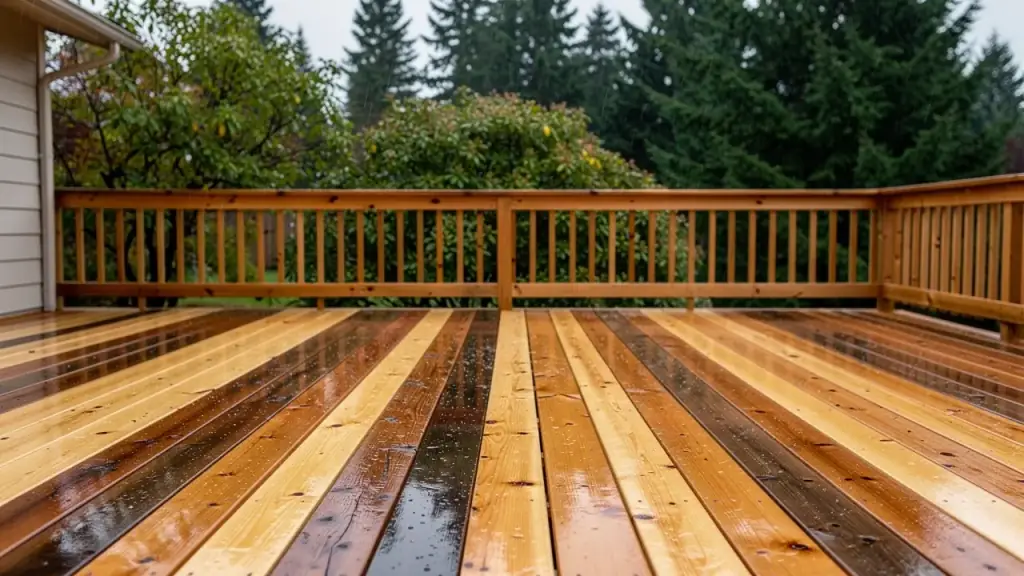
By March, a lot of decks in Mount Vernon look fine from the patio door and feel wrong underfoot. A Skagit winter is mostly rain, not hard frost, and that steady wet is what a deck has to survive. Boards that stay damp for months soften, fasteners rust, and the shaded side grows a film of moss before anyone notices.
You don't need a trained eye to do the first check. You need a dry afternoon, a screwdriver and about twenty minutes. Here's how to read what you find, and when a reseal is enough versus when a board or a railing needs to come out.
Start from underneath if you can
The top of a deck often looks better than the structure beneath it. If there's a crawl space, or even a gap you can see into, look at the joists, the beams and the ledger, which is the board that ties the deck to the house. Water collects where wood meets wood: at the ends of joists, around the posts, and along the ledger where the house wall drips onto it.
Press a screwdriver tip into the wood in those spots. Sound wood resists. Rotting wood lets the tip sink in easily and comes away stringy or crumbly. A dark stain by itself isn't rot, but a soft spot is. If you find one at the ledger or at a post base, say so when you call, because that's structure and not cosmetics.
Walk the boards
Walk the whole deck slowly, heel first, and pay attention to what you feel. A board that flexes more than its neighbors, or gives a little spring, is usually soft inside even if the surface looks sound. Check the ends of boards where they meet the joists, and the board next to the house wall, which stays wet longest.
- A screw that spins without gripping means the wood around it has gone soft.
- Boards with black streaks along the screw lines are holding water at the fasteners.
- Edges that flake or lift in long splinters have weathered, which isn't the same as rotten.
- Green or slick patches are moss or algae. They're a slip hazard, and they show you which spots stay wet.
Count the bad boards. A handful of soft ones is a swap job. A large share of the surface gone soft, or soft boards over soft joists, changes the conversation.
Shake every railing
Railings matter most on the day they fail. Put your hand on the top rail and push hard, sideways and outward, the way a person leaning or stumbling would. It shouldn't move more than a little. Then do the same at each post. Wobble at a post usually means the bolts have loosened or the wood around them has rotted. Wobble in the middle of a rail run often means a loose bracket or a failed screw.
Loose hardware can sometimes be tightened. Hardware that tightens up and then works loose again by the next week is telling you the wood behind it can't hold. That's a repair to the wood, not another turn of the screwdriver. Stairs get the same treatment: check the treads for flex and the stringers for softness where they meet the ground.
If a railing is loose on a deck that sits more than a step or two off the ground, keep people off that section until it's fixed.
Reseal or replace?
Resealing is for wood that's sound. If the boards are firm, the screws grip, and the surface has gone grey or patchy where water no longer beads up, a good clean and a fresh coat of sealer is the right move. It slows down the next winter's damage, and it works best when the moss has been cleaned off and the deck has dried fully first. In this climate that usually means waiting for a run of dry days. Sealer put over damp wood traps the moisture.
Replace when the wood has lost its strength. Soft boards, rotted ends, cracked boards that move underfoot, and railing posts that no longer hold bolts won't be helped by sealer. Sealing over rot hides it for a season, and then it shows up bigger. A fair rule is to seal what's sound, swap what's soft, and fix the structure before either.
Plenty of decks land in the middle: a few boards and one railing section to replace, then a seal over the lot. Swap first, seal second, and the deck weathers evenly.
What to tell the handyman
When you call or send a request, describe what you found in plain terms. Say where the soft spots are, how many boards you think are involved, which railing sections move, and whether the deck is high off the ground. Mention whether it's wood or composite. Photos of the soft areas and the post bases help a lot.
At the estimate, the handyman who comes out will take measurements, look at the framing, and give you a figure before any work starts. Materials can be supplied for you, or you can buy your own if you'd rather. Ask them to separate the safety repairs from the optional ones, so you can decide what fits this year.
Not sure whether your deck needs a reseal or a rebuild? Call 360-813-6743 or send a request, and describe what you're seeing.
The Mount Vernon Handyman, 360-813-6743
Call 360-813-6743More articles
How to write one handyman list that gets a real estimate
A single well-written request lets one visit cover a dozen small jobs and gives you one estimate you can actually compare.
Why siding and paint fail first on the wet side of the house
Three walls look fine and one doesn't, and that's rarely a coincidence.